
Can You Cut Vending Machine Energy Costs?

Last Updated: October 25, 2026
Quick Summary
You can cut vending machine energy costs without replacing equipment by measuring each machine's kilowatt-hours first, then retrofitting LED lighting, tightening refrigeration seals and coils, adding occupancy sensors and sleep mode, and keeping up with maintenance. Certified refrigerated beverage machines are on average 9% more efficient than standard models and save about 1,000 kWh annually.
Clip a plug-in electricity meter to one machine for a week to log a baseline in kWh/day.
Swap fluorescent tubes for LED strips to cut lighting watts and reduce heat inside the cabinet.
Clean condenser coils every 60 to 90 days and inspect door seals monthly.
Use the dollar-bill test to check whether a door seal has worn out.
A $300 LED and controls upgrade saving 400 kWh a year at $0.14 per kWh pays back near five years.
Table of Contents
What Vending Machine Electricity Consumption Actually Looks Like
Where the Power Goes: Cooling, Lighting, and Controls
Step 1: Measure Before You Change Anything
Build a Repeatable Baseline
Normalize for Operating Conditions
Verify Savings After Each Change
What to Do With the Numbers
Step 2: Upgrade Vending Machine LED Lighting
Step 3: Tighten Up the Refrigeration System
Compressors, Fan Motors, and Insulation
Maintenance That Preserves Efficiency
Placement and Ventilation
Setpoints and Operating Practices
When to Repair and When to Replace
Step 4: Add Smart Sensors and Power Management
Step 5: Keep Up With Vending Machine Refrigeration Maintenance
Should You Buy ENERGY STAR Vending Machines Instead?
Calculate Payback and Total Cost of Ownership
Frequently Asked Questions
What Vending Machine Electricity Consumption Actually Looks Like
Vending machine energy is one of the most overlooked line items in a facility budget, and vending machine energy waste rarely shows up until someone measures it. According to ENERGY STAR's vending machine product page, certified refrigerated beverage machines are on average 9% more efficient than standard models and save about 1,000 kWh annually.
At Benny's Vending, we see this constantly across Minnesota facilities. A machine that hums along quietly can quietly drain hundreds of dollars a year.
Here is the good news. You do not need to replace equipment to cut that waste. A focused retrofit and maintenance routine can lower electricity use on machines you already own.
Below, we walk through five steps that work in order, from measuring first to maintaining last.
Where the Power Goes: Cooling, Lighting, and Controls
Cooling eats most of the power. The compressor and fan motors run hardest when a machine fights warm room air or clogged coils.
Lighting is the second draw. Older fluorescent tubes burn more watts than LED strips and add heat the compressor must remove.
Controls decide how often the machine runs at all. A machine with no sleep mode cools all night whether anyone is buying or not.
Compressor and fans: the largest share of electricity use
Lighting: fluorescent lighting wastes watts and adds heat load
Controls: no power management means constant cooling during idle periods
Step 1: Measure Before You Change Anything
Start with data, not guesses. Clip a plug-in electricity meter to one machine for a week and log the kilowatt-hours. Compare that number to the machine's rated draw.
This baseline does two things. It shows which machines waste the most, and it gives you a before-and-after number to prove savings later.
A common mistake is skipping this step and buying upgrades blind.
Build a Repeatable Baseline
A single week of data is a start, but a baseline you can defend needs a consistent method. Use the same meter, the same logging interval, and the same days of the week for every machine you compare.
Convert everything to a common unit: kilowatt-hours per day (kWh/day). A machine that logs 84 kWh over seven days is running at 12 kWh/day. That number is what you compare across machines and against your post-upgrade readings.
Normalize for Operating Conditions
Raw kWh/day hides the conditions that drive energy use. Two identical machines can differ by 20% or more simply because one sits in a warm hallway and the other in a cool break room. Note these conditions alongside your readings:
Ambient temperature at the machine's intake
Whether the machine sits in direct sun or near a heat source
Daily sales volume or vend count, if the machine reports it
If you cannot control for every variable, at least record them. When you compare before-and-after numbers, compare like conditions to like conditions. A savings claim made against a cooler week is not a savings claim at all.
Verify Savings After Each Change
After each retrofit, run the meter again for the same number of days under similar conditions. Subtract the new kWh/day from the baseline kWh/day, multiply by 365, and multiply by your electricity rate. That is your annualized savings estimate.
Pro Tip Log your readings in a simple spreadsheet with columns for machine ID, date, days logged, total kWh, kWh/day, ambient temperature, and notes. A shared log lets you compare machines and spot drift over time without re-learning the method each quarter.
What to Do With the Numbers
Rank machines by kWh/day and by kWh per vend if you have vend counts. The worst performers are your first retrofit targets.
Keep the baseline log. When you replace a machine or add a new one, you will want a starting number to compare against, and when a utility incentive or internal budget review asks for proof of savings, the log is your evidence.
Step 2: Upgrade Vending Machine LED Lighting
Vending machine LED lighting is the cheapest, fastest win available.
Less heat inside means the refrigeration system works less. That is a double saving from one small change.
A lighting retrofit takes under an hour per machine.
Watch out: cheap LED strips with poor drivers can fail early and flicker. Buy strips rated for cold, enclosed spaces, not general room lighting.
Step 3: Tighten Up the Refrigeration System
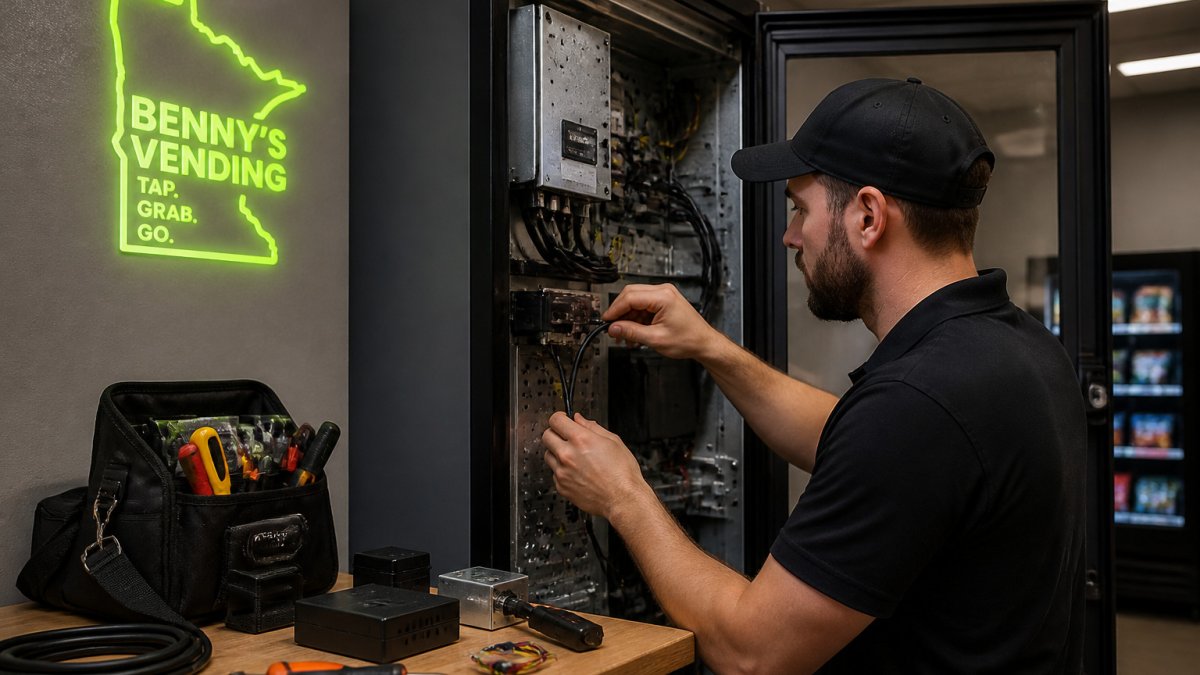
The refrigeration system is where the real money sits. A compressor that runs long cycles because of dirty coils or worn door seals will always cost more than it should.

Compressors, Fan Motors, and Insulation
Three parts deserve your attention.
Compressors. Variable-speed compressors adjust output to demand instead of cycling on and off at full power. If a compressor is nearing replacement, this is the upgrade to price out.
Fan motors. Efficient fan motors move the same air with less draw. They also run cooler, which helps the whole cabinet.
Insulation. Better insulation thickness and door seals keep cold air in and warm room air out.
Maintenance That Preserves Efficiency
Every upgrade you pay for can be erased by skipped maintenance. A dirty condenser coil forces the compressor to run longer, and the loss shows up within months. Build these actions into a routine:
Clean condenser coils every 60 to 90 days, more often in dusty or high-traffic locations
Vacuum fan blades and check for obstructions that block airflow
Inspect door seals monthly and replace any that fail the dollar-bill test
Log cabinet temperatures weekly to catch drift before it becomes a repair
A common pattern is that operators clean coils once, see the improvement, and then let the schedule slip. Put the cleaning on a calendar with a named owner so it actually happens.
Placement and Ventilation
Where a machine sits matters as much as what is inside it. Refrigeration systems reject heat, and they need clearance to do it. Follow the manufacturer's clearance specification for the back and sides, and never push a machine tight against a wall or into a closet to save floor space.
Keep machines out of direct sun and away from heat sources such as radiators, ovens, or server racks. A machine fighting warm ambient air runs longer cycles no matter how efficient its components are.
Setpoints and Operating Practices
Temperature setpoints should match the product mix, not be set colder than needed. Colder setpoints increase compressor run time and energy use. Review setpoints with your service provider and adjust only within the range the product requires.
Stocking practices also affect efficiency. Overloading a machine blocks airflow and forces the refrigeration system to work harder. Keep product below the load line and leave space for air to circulate.
Watch Out Aggressive energy-saving settings can warm product slightly. Set sleep modes, dimming, and temperature controls with your product mix in mind, and check product temperatures after any change.
When to Repair and When to Replace
If a compressor is failing, price both a replacement and a new machine before committing. A cabinet that is otherwise sound often justifies a compressor or fan motor replacement. A machine with a failing compressor, worn cabinet, and dated controls is usually a replacement candidate. Use your baseline kWh/day numbers to compare the two paths on expected annual savings, not just on purchase price.
Step 4: Add Smart Sensors and Power Management
Smart sensors and power management cut waste during idle periods.
Automatic controls also handle temperature control more precisely than a fixed thermostat.
According to SMUD's Business Energy Advisor guidance, efficiency improvements for vending machines include better lighting, insulation, efficient or variable-speed compressors, and controls.
One trade-off: aggressive sleep settings can warm product slightly. Set them with your product mix in mind.
Step 5: Keep Up With Vending Machine Refrigeration Maintenance
Vending machine refrigeration maintenance protects every upgrade you just paid for. A dirty condenser coil forces the compressor to run longer, wiping out efficiency gains within months.
Build a simple routine:
Clean condenser coils every 60 to 90 days
Vacuum fan blades and check for obstructions
Inspect door seals monthly
Log temperatures to catch drift early
For a fuller preventive schedule, our vending machine maintenance tips for managers cover checklists and troubleshooting. Small operations can start with our guide to vending machine maintenance for small businesses.
Should You Buy ENERGY STAR Vending Machines Instead?
Sometimes replacement beats retrofit. ENERGY STAR vending machines are the clearest benchmark for efficiency requirements and product specifications, and the certification covers compressors, fan motors, and lighting systems.
Buy new when a machine is old, failing, or costing more in repairs than it earns. Retrofit when the cabinet is sound and only components are dated.
If you are weighing a replacement, you can browse our vending machines to see what modern equipment looks like.
Calculate Payback and Total Cost of Ownership
Payback math is simpler than it looks. Take the annual kilowatt-hour savings, multiply by your electricity rate, and divide the upgrade cost by that yearly figure.
Example: a $300 LED and controls upgrade that saves 400 kWh a year at $0.14 per kWh returns $56 annually. Payback lands near five years.
Total cost of ownership must include hidden fees. Our guide to smart vending machine hidden fees explains transaction processing, software subscriptions, and connectivity charges. For a full comparison, read are smart vending machines worth it.
Upgrade | Typical Payback | Best For |
LED lighting retrofit | 2-5 years | Every machine |
Door seal replacement | Under 1 year | Worn seals |
Occupancy sensors | 2-4 years | Low-traffic sites |
Variable-speed compressor | 3-6 years | Aging units |
Full machine replacement | Varies | Failing equipment |
Frequently Asked Questions
Do vending machines use a lot of electricity?
A refrigerated beverage machine runs its compressor and fans around the clock, so it draws power even when nobody is buying. ENERGY STAR reports that certified refrigerated beverage machines are about 9% more efficient than standard models and save roughly 1,000 kWh per year. That gap is why vending machine energy is worth auditing: a single older unit can quietly add hundreds of dollars to a facility's annual electricity bill.
How can I measure a vending machine's energy consumption?
Plug the machine into a plug-in electricity meter for one full week, including a weekend. That captures idle periods, defrost cycles, and busy lunch hours in kilowatt-hours. Divide the weekly total by seven for a daily average, then multiply by your utility rate to get a dollar figure. Repeat the reading after any retrofit so you can verify savings instead of assuming them.
Are ENERGY STAR vending machines more energy efficient?
Yes. ENERGY STAR-certified refrigerated beverage machines use more efficient compressors, fan motors, and lighting systems, and the program reports they are on average 9% more efficient while saving about 1,000 kWh annually. If a machine is near the end of its life, replacing it with a certified model often beats retrofitting. For units with years left, LEDs, sensors, and maintenance usually deliver savings sooner.
Does turning off vending machine lights save energy?
It saves a little, but lighting is the smaller load next to refrigeration. A vending machine LED lighting retrofit cuts the lighting draw sharply and keeps the machine looking bright, which matters for sales. The bigger wins come from occupancy sensors and sleep mode, which idle the compressor and fans during quiet hours. Pair lighting upgrades with controls rather than choosing one or the other.
Cutting vending machine energy costs comes down to measurement, a few targeted upgrades, and a maintenance routine that holds the gains. Benny's Vending handles installation, maintenance, and restocking for Minnesota businesses, with AI-powered smart stores, real-time inventory tracking, and zero-cost, no-contract options. Get started with Benny's Vending and turn your break room into a leaner, more reliable amenity.
Request a Machine
Add bennys-vending.com as a preferred source on Google →

Comments