
Smart Vending Machines for Offices: Benefits & ROI

Table of Contents
What Smart Vending Machines Deliver to Modern Offices
Real-Time Inventory Management and Smart Restocking
Contactless Payment Solutions That Drive Sales
Operational Efficiency: Reducing Service Trips and Downtime
Employee Productivity and Workplace Satisfaction
Cost-Benefit Analysis of Office Vending Machines
Why Smart Vending Outperforms Traditional Options
Frequently Asked Questions
Last Updated: September 30, 2026
What Smart Vending Machines Deliver to Modern Offices
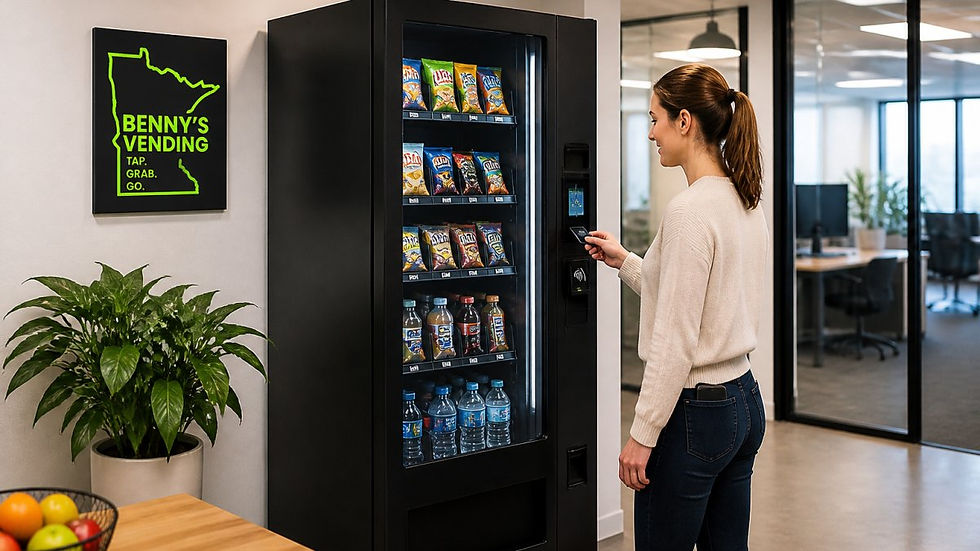
Smart vending machines offices combine real-time inventory tracking, AI-driven product recommendations, and contactless payment technology to create the "Tap, Grab, and Go" experience. The real value is eliminating friction that frustrates employees and wastes operational resources.
The numbers underscore why offices are making this transition. According to Business Research Insights' 2026 analysis of smart vending adoption, smart vending machines increase employee convenience by 33% while simultaneously reducing operational costs by 21%.
Cloud-based systems monitor stock levels in real time, predict sellouts, and trigger restocking before empty shelves occur, reducing wasted trips, downtime, and customer frustration.
Real-Time Inventory Management and Smart Restocking
Smart vending machines use telemetry to report exact stock levels item-by-item, eliminating the guesswork of traditional scheduled restocking.
Cloud-based systems aggregate data across machines, allowing operators to optimize routes and combine stops. What used to require three separate service trips now consolidates into one, cutting labor costs and carbon emissions.
Smart vending systems track behavioral data, which products move fastest, when sales peak, preference patterns, enabling facility managers to stock what people actually want and reduce waste.
Centralized visibility eliminates communication gaps: the system flags problems automatically, and operators prioritize repairs based on traffic patterns.
Contactless Payment Solutions That Drive Sales
Smart vending machines support mobile wallets, tap cards, and QR-code scanning, eliminating the friction of carrying coins or cash.
Cashless payment systems boost sales: when payment friction disappears, impulse purchases increase.
Transaction-level data feeds inventory optimization and product assortment decisions, identifying which products generate revenue versus which sit untouched.
Machines no longer accumulate cash, reducing theft risk and cash reconciliation overhead.
Pro Tip Modern smart vending machines accept multiple payment methods simultaneously, mobile wallets, contactless cards, and QR codes. Offering choice removes the single point of failure that plagued older systems where one broken card reader meant lost sales.
Operational Efficiency: Reducing Service Trips and Downtime
Traditional vending required scheduled maintenance visits regardless of actual need, leaving customers frustrated for days when problems went undetected.
Remote diagnostics report equipment faults in real time, shifting from scheduled maintenance to fault-triggered response and reducing unnecessary visits.
The numbers reflect this efficiency. According to research from Modern Amenities' 2026 operational analysis, cloud-based systems and remote diagnostics significantly slash machine downtime compared to traditional approaches. For a busy office with hundreds of employees, even a single day of machine downtime represents lost sales and frustrated users.
Operators visit only when data indicates a problem exists, reducing wasted service trips.
Operators order replacement parts before arriving on-site, ensuring machines stay operational longer.
Employee Productivity and Workplace Satisfaction
Smart vending machines make the connection between amenities and satisfaction measurable. When employees waste time searching for working machines or discovering empty shelves, productivity suffers across the entire office.
Quantifying Time Savings
Traditional vending takes longer per transaction; smart vending is faster. For an employee making one visit daily, smart vending saves time daily, aggregating to significant recovered productivity annually.
High-traffic offices see 2-3 visits per employee per week, scaling time savings accordingly. Smart vending also eliminates frustration from empty machines or broken payment systems.
Workplace Satisfaction and Retention
A 2024 SHRM survey found that 62% of employees consider workplace amenities important to job satisfaction, and 41% would consider leaving if amenities were removed. Smart vending signals organizational investment in employee experience.
Modern, frictionless amenities contribute to workplace quality perceptions and influence hiring decisions. Candidates notice whether vending feels outdated or modern during office tours.
Offices that upgraded to smart vending report improvements in employee satisfaction scores related to workplace convenience.
Integration with Wellness and ESG Programs
Smart vending systems provide product-level sales data that facility managers can use to align vending with wellness and ESG initiatives.
Smart vending data reveals which healthier snack options employees purchase, enabling facilities teams to coordinate with wellness programs and demonstrate effectiveness. Some offices report increases in health initiative participation.
Smart vending reduces waste through predictive inventory management and consumes less energy than older units, supporting ESG commitments.
Office Management System Integration
Smart vending integrates with facility management platforms, allowing managers to monitor machines through the same dashboard as HVAC and lighting, reducing administrative overhead.
Vending data can be cross-referenced with occupancy patterns to optimize placement and inventory, and helps inform renovation planning, coordination impossible with traditional operators.
Measuring Satisfaction Outcomes
Offices can track satisfaction improvements through multiple channels. Post-upgrade surveys asking employees about break room and vending experiences typically show improvement in satisfaction scores. Usage data from smart machines (transaction frequency, product selection patterns) provides behavioral evidence of increased engagement. Some offices also track break room dwell time using occupancy sensors; improved vending experiences often correlate with slightly longer, more relaxed break periods, suggesting employees feel less rushed and more satisfied with their break experience.

Pro Tip Smart vending machines generate transaction data that facility managers can use to align vending inventory with wellness program goals, ESG targets, and employee preferences, turning a simple amenity into a strategic tool for workplace culture and sustainability.
Cost-Benefit Analysis of Office Vending Machines
The ROI calculation for smart vending machines requires understanding both the revenue side and the cost side, but more importantly, it requires a framework that office managers can present to finance teams. Unlike traditional vending, smart machines generate measurable data at every step, making the business case transparent and defensible.
Revenue Calculation
Start with machine placement and traffic. A single machine in a high-traffic office location can generate significant monthly revenue, translating to substantial annual figures per machine. However, revenue varies significantly by location. A machine positioned near a busy conference room or high-traffic corridor outperforms one in a remote hallway. Smart vending systems provide location-based sales data, allowing you to optimize placement before committing to long-term contracts.
Cost Structure and Labor Savings
Traditional vending requires fixed restocking schedules: a technician visits every machine weekly regardless of actual need. This generates predictable but wasteful labor costs. Smart vending shifts from scheduled maintenance to demand-triggered service. When inventory data shows a machine is 85% stocked, no visit is necessary. When a fault is detected, the operator arrives with the correct replacement part, eliminating diagnostic trips.
The labor efficiency gain is substantial. Traditional vending typically requires more frequent service visits per machine per month. Smart vending reduces this, leading to a significant reduction in service labor. For an operator managing 20 machines, this translates to roughly 10-20 fewer service hours monthly. At a fully loaded technician cost, that translates to substantial monthly labor savings per route.
Payment processing fees also differ. Contactless and mobile payment systems typically charge a percentage per transaction, but this cost is offset by increased sales volume (cashless payment boosts impulse purchases) and eliminated cash handling labor (collection, counting, deposit reconciliation).
Payback Period Framework
Here's a practical calculation template for a typical office scenario:
Assumptions:
Machine cost: (zero-cost placement model)
Monthly revenue per machine: (conservative mid-range estimate)
Monthly service labor savings: (based on reduced visits across a multi-machine route)
Monthly payment processing fees: (a percentage of revenue)
Monthly connectivity and cloud platform cost: (allocated per machine)
Net monthly benefit: (calculated per machine)
For offices using a zero-cost, no-contract placement model (where the vending operator owns and maintains machines), the payback is immediate: the office receives improved employee amenities and operational efficiency with zero capital expenditure. For offices purchasing machines directly, a machine investment breaks even in a few months based on net revenue and labor savings alone.
Broader Cost Avoidance
Beyond direct revenue and labor, smart vending eliminates several hidden costs:
Downtime frustration: A broken traditional machine can sit non-functional for days. Each day of downtime represents lost sales and employee dissatisfaction. Smart vending's real-time fault detection reduces downtime from days to hours.
Waste reduction: AI-driven inventory prevents overstocking of slow-moving items. Traditional vending often results in stock expiring unsold. Smart systems reduce this through predictive restocking.
Facility management integration: Modern smart vending platforms integrate with facility management software, reducing the administrative overhead of coordinating with external vending operators. One facilities manager can monitor multiple machines and service requests through a single dashboard instead of managing separate vendor relationships.
Wellness Program Alignment
Offices with active wellness initiatives can use smart vending data to amplify program ROI.
Key Takeaway For most offices, the payback period for smart vending machines is typically a few months when accounting for labor savings, revenue, and waste reduction. For zero-cost placement models, the ROI is immediate: improved employee experience and operational efficiency with no upfront investment.
Why Smart Vending Outperforms Traditional Options
The gap between smart vending and traditional mechanical machines has widened considerably since AI-driven systems became mainstream. Traditional vending relies on mechanical coin mechanisms, fixed product layouts, and operator intuition about what to stock. These systems work, but they're inefficient and create frustrating user experiences.
Frequently Asked Questions
What are the main advantages of smart vending machines in offices?
Smart vending machines increase employee convenience while reducing operational costs. They use real-time inventory tracking and AI-driven recommendations to eliminate stockouts and wasted service trips. Touchless payment options and 24/7 availability mean employees grab snacks without disrupting their workday. Cloud-based systems let you monitor stock levels remotely, slashing downtime and ensuring consistent product availability.
How does smart vending machine inventory management reduce operational costs?
IoT-enabled inventory tracking provides supply chain visibility, so operators know exactly which products are running low before stockouts occur. This eliminates wasted service trips, a single snack machine in a busy office can generate significant monthly revenue, but only if it's stocked efficiently. Predictive maintenance alerts warn of hardware issues before they cause downtime, and automated reporting reduces the time spent on manual checks. The result is fewer unnecessary visits and faster restocking cycles.
Are contactless payment vending solutions worth the investment?
Yes. Telemetry data shows that cashless payment systems boost overall sales and increase consumer convenience. Touchless interfaces reduce friction, employees complete transactions faster, which encourages repeat purchases. Digital displays paired with AI-driven product recommendations guide purchasing decisions, further increasing transaction value. For offices with high foot traffic, contactless systems pay for themselves through increased sales volume and reduced cash handling labor.
How do I calculate ROI for a smart vending machine in my office?
Start with revenue: a single machine in a busy office generates significant monthly revenue. Subtract operational costs (restocking, maintenance, payment processing). Factor in labor savings, remote diagnostics and real-time inventory tracking eliminate time-consuming manual checks. Add employee retention value: improved workplace amenities increase satisfaction and reduce turnover costs. Most offices see positive ROI within a reasonable timeframe, especially when machines are placed in high-traffic areas and stocked with products employees actually want, informed by data analytics.
Request a Machine


Comments